Planning Output Under 18,000 Barrels a Year
Eighteen thousand barrels a year is the published ceiling for a microbrewery, and it is a much bigger number than most people picture: about 2.1 million litres, or 21,060 hectolitres. The micro craft brewery system that HGMC publishes as a 1,000 L to 3,000 L range sits underneath that ceiling, so the planning question is not whether the plant qualifies but how many brews a week it has to run to get near the line.
Key takeaways
- HGMC publishes microbrewery equipment as producing 18,000 barrels or less of beer every year, which is about 2,106,000 L or 21,060 HL.
- The micro craft brewery system is published as a 1,000 L to 3,000 L range, sized for restaurants and commercial or industrial breweries.
- A nano brewery is published as 5 BBL or less and takes little space, while large commercial systems run up to 100 HL.
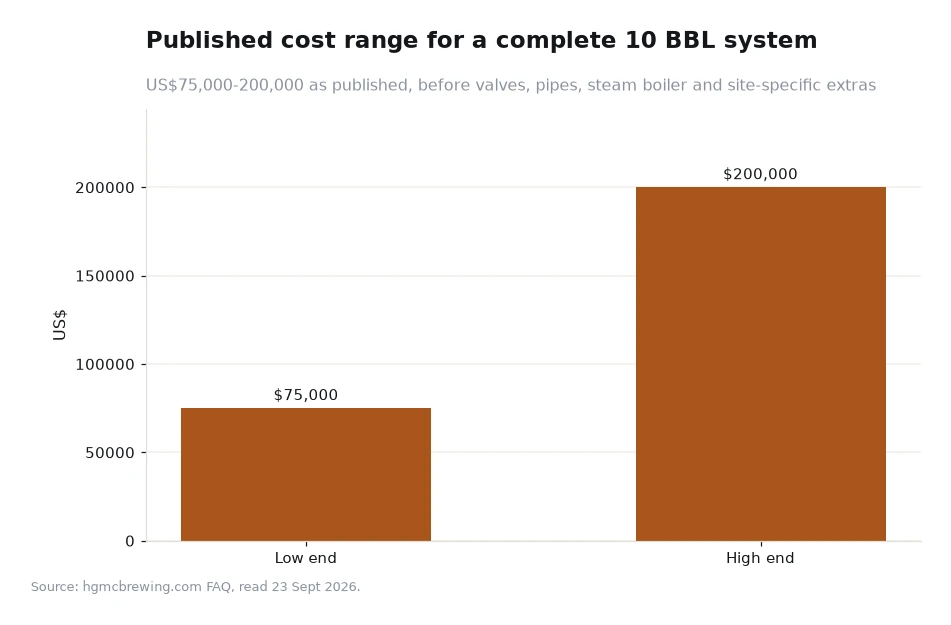
- The published price example of US$75,000 to US$200,000 is for a complete 10 BBL system, plotted below, and sits inside the small end of this class.
What 18,000 barrels means in litres and hectolitres
The published wording is that microbrewery equipment produces 18,000 barrels or less of beer every year. Using the published conversion of 1 BBL at about 117 L, that ceiling is 18,000 multiplied by 117, which is 2,106,000 L, or 21,060 HL. Spread across 52 weeks it is 40,500 L a week of packaged beer. Those conversions are arithmetic rather than manufacturer data, but they are the numbers a planning decision actually has to sit inside.
Read the ceiling as a class definition rather than as a target. A brewery under 18,000 barrels a year is a microbrewery in the published sense; a nano brewery is published separately at 5 BBL or less. The practical value of the definition is that it tells a buyer which equipment family a project belongs to before any quotation is written, and it explains why the same manufacturer publishes both a small-batch range and large commercial systems up to 100 HL.
The published size classes, and where a project fits
Size class is decided by annual output and by the batch volume that has to be brewed to reach it. The published ranges give a starting point for each class, and the fit column is where a project usually decides itself.
| Size class | Published capacity | Published annual context | Typical fit |
|---|---|---|---|
| Nano brewery | 5 BBL or less | Takes little space | Taproom or in-restaurant brewing |
| Micro craft brewery system | 1,000 L to 3,000 L | Microbrewery equipment produces 18,000 barrels or less a year | Restaurants and commercial or industrial breweries |
| Large commercial system | Up to 100 HL | Commercial sizes quoted from 1 HL to 500 HL | Plants scaling past the micro class |
Planning brews per week against the ceiling
Once the ceiling is expressed in litres, the batch volume and the brews per week become the only two variables. A larger batch buys headroom with fewer brew days, which matters because every brew day carries its own cleaning, changeover and quality-control load regardless of size. A smaller batch gives flexibility on style and tank turns, and it uses less capital at the start.
The published equipment advantages point at the same trade-off from the other side. HGMC describes design matched to the customer's brewing method and beer types, energy saving with higher brewing efficiency and lower material consumption, and fully automatic mash, wort and water flow with automatic temperature control. On a plant running four or five brew days a week, that automation is what keeps the days consistent rather than merely shorter.
Headroom is worth protecting. A brewery that plans to sit exactly at the ceiling has no room for a good month, a contract order or a seasonal spike, and the class boundary is defined by annual output rather than by nameplate capacity. Most planning teams aim for a batch size that reaches the ceiling at a realistic brew count and can be slowed down when demand dips.
Tank turns, cooling and packaging
Annual output is not set by the brewhouse alone. Fermentation and bright tank capacity, cooling and packaging each cap the site in turn. HGMC supplies fermentation tanks and bright tanks alongside the brewhouse, and the published control levels run from a PID display panel through a PLC semi-automatic touch screen to a PLC fully automatic panel with curve indication and production-record printing. On a busy plant the printed record matters as much as the temperature curve itself, because it is what lets a head brewer compare one week with the next.
Packaging is where small plants most often stall. Published equipment families cover beer filling machines for bottles and cans, and the choice between them changes the labour profile rather than the output figure. Fabrication standards are published as TIG 100 per cent full welding joints, polishing accuracy of 0.4 μm or finer, stainless steel 304 or 316 with plate thicknesses of 3 mm and 2 mm, and SUS304 food-grade material certified by SGS, with the quality system in compliance with ISO9001:2015 and products exported to more than 120 countries.
Worked example
Worked example, with every assumption stated. Take the top of the published micro craft range, 3,000 L per batch, and assume 12 brews a week for 52 weeks. Arithmetic: 3,000 L multiplied by 12 is 36,000 L a week, and 36,000 multiplied by 52 is 1,872,000 L a year. Dividing by the published conversion of 117 L per BBL gives 16,000 BBL, which leaves 2,000 BBL of headroom under the published 18,000 BBL ceiling.
Run the same arithmetic at the bottom of the range. A 1,000 L batch at 12 brews a week is 12,000 L a week, or 624,000 L a year, which is about 5,333 BBL. The two extremes of the published range therefore differ by a factor of three, which is the whole point of offering a range rather than a single model.
Finally, express the ceiling in brew counts. The 18,000 BBL ceiling is 2,106,000 L a year, or 40,500 L a week. At 1,000 L a batch that is 40.5 brews a week, which is not a realistic single-brewery schedule; at 3,000 L it is 13.5 brews a week, which is demanding but achievable with two shifts. The four price and volume figures published for a complete 10 BBL system, US$75,000 to US$200,000 before valves, pipes, steam boiler and site-specific extras, are shown in the chart below; at about 1,170 L a 10 BBL system sits inside the small end of this class rather than at its top.
Frequently asked questions
What counts as a microbrewery in the published size classes?
The manufacturer publishes microbrewery equipment as producing 18,000 barrels or less of beer every year, which converts to about 2,106,000 L or 21,060 HL using the published 1 BBL at 117 L conversion, and the micro craft brewery system itself is published as a 1,000 L to 3,000 L range.
How many brews a week does the ceiling require?
At 3,000 L per batch, 12 brews a week for 52 weeks reaches 16,000 barrels, while at 1,000 L the same brew count reaches about 5,333 barrels, so batch size rather than brew count is the variable that decides how far up the class a plant sits.
Setting the plan before the quotation
Decide the annual barrel target first, convert it into litres a week, and only then choose a batch size that reaches it at a brew count the team can actually sustain. The published craft beer equipment page covers the 1,000 L to 3,000 L micro range, and the brewery systems section shows how it relates to the large commercial class. Fermentation and bright tank sizing is set out alongside, and the free 2D, 2.5D and 3D design service is where a brew count gets tested against the building. If the plan may cross into the large commercial class later, the beer brewing range is the next step up.
The class definitions and wording used here come from the manufacturer's own website, read 23 Sept 2026: microbrewery equipment at 18,000 barrels or less a year, the 1,000 L to 3,000 L micro craft brewery system, the nano brewery at 5 BBL or less, large commercial systems up to 100 HL, the three control levels, the fabrication and material specification, the ISO9001:2015 quality system, and the 10 BBL price range of US$75,000 to US$200,000.[1] Barrel and litre conversions and the brew-count arithmetic are labelled planning work.