Crypto Mining Arithmetic at 217 TH/s, 868 TH/s and 2.17 PH/s
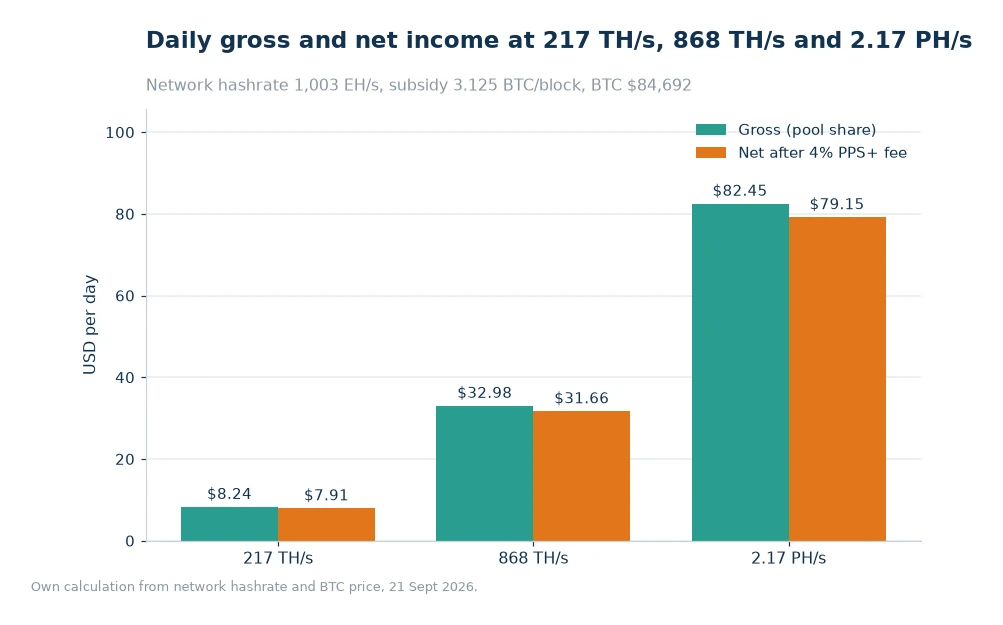
The formula for mining income does not care which coin is on the other end, and that is the useful part. At 217 TH/s the credit is 0.000097358 BTC a day, or $8.24 gross and $7.91 net; at 2.17 PH/s the same three figures are 0.00097358 BTC, $82.45 and $79.15. Everything else is a decision about which chain that hash points at.

Key takeaways
- 217 TH/s earns 0.000097358 BTC a day, which is $8.24 gross and $7.91 net at BTC $84,692.
- 868 TH/s is four times that and 2.17 PH/s is ten times it, with the same net margin per terahash.
- The listed 4% applies to the block-reward component, not to the whole credit.
- More than 20 coins are available on the same account, including BTC, BCH, LTC/DOGE, KAS, ZEC, HNS, CKB and ETC.
One account, many chains
A multi-coin pool is a settlement layer with several ledgers attached. The work is submitted the same way regardless of the coin, the difficulty of the chosen chain converts it into an expected reward, and the account keeps a balance per coin. That is why a miner can hold BTC, BCH, LTC/DOGE, KAS, ZEC, HNS, CKB and ETC balances without running separate infrastructure for each.
The benefit is administrative rather than magical. One login, one set of payout addresses, one place to see hashrate. The coin choice still determines the difficulty, the price and the variance, so the formula below is a value calculation rather than a promise about any particular chain.
Three rungs on the same formula
Each row multiplies the same daily rate: 450 BTC a day divided by a 1,003 EH/s network, which is 0.00000044865 BTC per TH/s per day. Net applies the listed 4% to the block-reward component.
| Hashrate | Daily BTC | Gross USD/day | Net USD/day |
|---|---|---|---|
| 217 TH/s | 0.000097358 | $8.24 | $7.91 |
| 868 TH/s | 0.00038943 | $32.98 | $31.66 |
| 2.17 PH/s | 0.00097358 | $82.45 | $79.15 |
The three rungs are chosen to make the scaling obvious: 868 is four times 217, and 2,170 is ten times. A miner who knows the 217 TH/s row can produce the other two in their head, which is useful during a negotiation about adding machines or moving a container.
Worked example
Start at 217 TH/s and carry the figures to a month.
- 450 BTC a day ÷ 1,003,000,000 TH/s = 0.00000044865 BTC per TH/s per day.
- 217 TH/s × 0.00000044865 = 0.000097358 BTC a day.
- 0.000097358 × 84,692 = $8.245, rounded to $8.24.
- 4% of $8.24 is $0.33, so net is $7.91.
- 868 TH/s: 4 × 0.000097358 = 0.00038943 BTC, and 0.00038943 × 84,692 = $32.98.
- 2.17 PH/s: 10 × 0.000097358 = 0.00097358 BTC, and 0.00097358 × 84,692 = $82.45.
- Net at 2.17 PH/s: $82.45 × 0.96 = $79.15.
- Thirty days at 217 TH/s: 30 × 0.000097358 = 0.00292074 BTC, or $247.36 gross and $237.48 net.
Why the coin choice changes the shape
The formula above is BTC-denominated, so it answers what a given amount of hash is worth in the unit most miners use to compare. Point that hash at another chain and the shape changes: a different network hashrate, a different block interval, a different subsidy and a different price. The account still credits a balance, but the daily figure will not match the BTC-equivalent one.
That is not a flaw in the table, it is a reason to keep two sheets. One sheet holds the BTC-equivalent value, which is stable enough to compare months. The other holds the actual coin balance and its price, which is what pays a bill. A miner who only keeps the second sheet will mistake a price move for a change in performance.
Three figures worth tracking weekly
Reported hashrate, credited balance and power draw. The first tells you whether the machine is doing the work, the second whether the work is being paid, and the third whether the work is worth doing. Any two without the third produce a comfortable illusion.
The ViaBTC Crypto Mining account puts the first two on one screen, and the payout page shows the conversion between the credited coin and the BTC-equivalent value used above. Check the three numbers on the same day each week; a pattern is easier to spot than a single reading.
Costs at each rung
At 217 TH/s a machine drawing about 3.4 kW at $0.07 per kWh costs $5.71 a day to run, which leaves $2.20 of the $7.91 net. At 868 TH/s the same rate leaves $8.80, and at 2.17 PH/s it leaves $22.02, because the power cost scales with the hashrate while the rate per kilowatt-hour stays fixed.
The absolute margin grows and the percentage margin does not, which is the point most often missed when a miner plans a build-out. Doubling the machines doubles the dollars left over and doubles the capital at risk. Whether that is progress depends on the power contract and on how much idle cash the operation can carry through a bad month.
There is a break-even hashrate hiding in those figures, and it is worth calculating once. Net value per terahash is 0.00000044865 × 0.96 × 84,692, which is about $0.0365 a day. A 3.4 kW load at $0.07 per kWh costs $5.71 a day, so the rig needs roughly 157 TH/s just to cover power. At 217 TH/s it clears that line with room; a machine that degrades to 150 TH/s through heat or failing boards stops covering its own electricity, which is the quiet way a profitable setup turns negative.
The question the formula cannot answer
It cannot tell you whether the difficulty will rise, whether the price will hold, or whether a board will fail on a Friday night. It can tell you the break-even hashrate at a given power rate, which is the number that makes those other questions smaller. Everything above is that break-even arithmetic with a few multipliers attached.
Keep the break-even figure beside the rated hashrate and check it whenever a machine is serviced. A rig that has lost two boards still runs, still reports shares and still looks healthy on a dashboard, while its hashrate has fallen close to the line where the power bill wins. That check takes a minute and catches a failure mode that alerting usually misses.
It also cannot tell you which coin to mine. That decision depends on the hardware's efficiency on each algorithm, the local power cost, and the liquidity of the coin you are paid in. The pool supports many chains precisely because there is no single answer that fits every site.
Frequently asked questions
How much does 217 TH/s earn per day?
About 0.000097358 BTC, or $8.24 gross and $7.91 net at BTC $84,692, using a 1,003 EH/s network and the listed 4% on the block-reward component.
Do different coins change the daily figure?
Yes, because each chain has its own network hashrate, block subsidy and price. The BTC-equivalent figure is a value ruler for comparing months; the coin balance and its price decide what actually pays a bill.
Is the fee the same on every coin?
The listed rates are stated per component rather than per coin: 4% on the PPS-settled block reward and 2% on the transaction-fee component under PPS+, with 2% on the combined reward and fees under PPLNS.
Build the sheet before the shed
Three columns are enough to start: hashrate, net daily value and power cost. Add a fourth for the coin balance if the operation spans more than one chain. With those four, a miner can answer the questions that actually come up, which are whether to add a machine, whether to move a container, and whether the current power rate still works.
The Profit Calculator rebuilds the daily value from current difficulty and price, and the Miner Profitability Ranking shows which models clear their power cost today. Use both before committing to a rung on the table above.
Sources: the ViaBTC homepage, calculator and miner ranking pages, with chain data read 21 Sept 2026[1]. Network hashrate 1,003 EH/s, difficulty 132.76 T, 3.125 BTC per block, 144 blocks a day, BTC $84,692. Published 22 Oct 2026; figures assume continuous uptime and a steady difficulty.