What Defines a High-Quality Period Underwear Manufacturer?
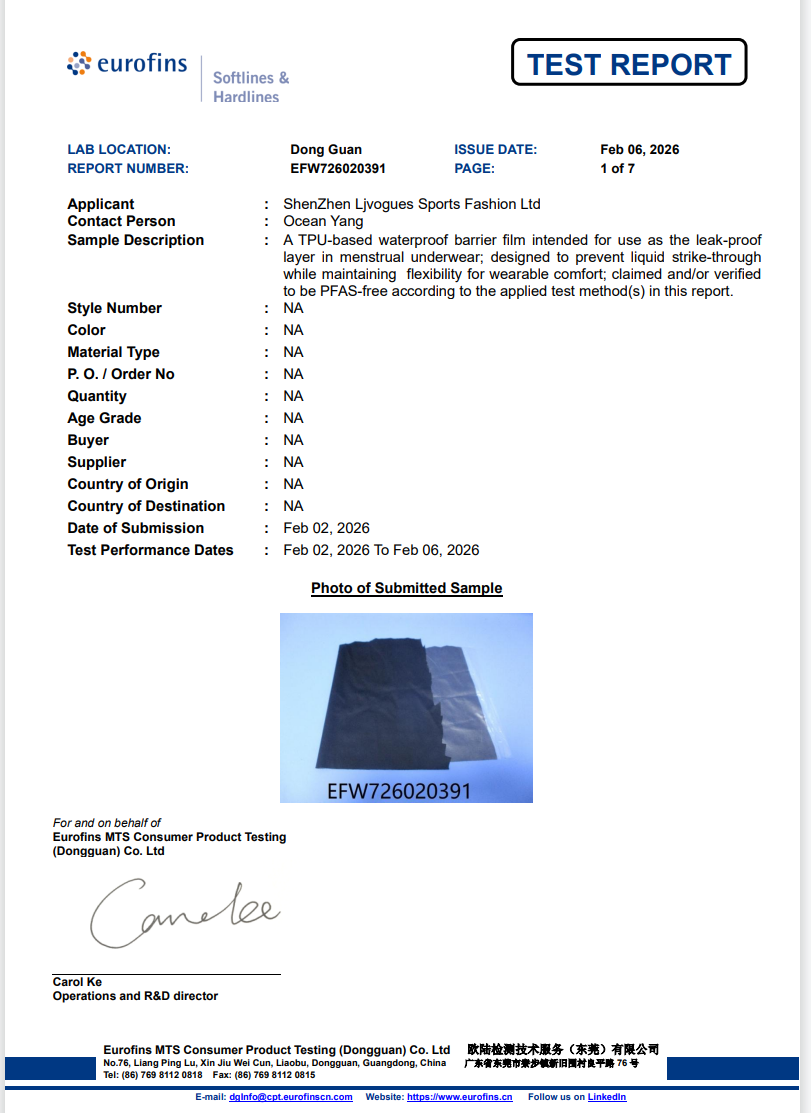
A high-quality period underwear manufacturer controls far more than stitching. A dependable factory verifies absorbency, liquid transfer, barrier resistance, shrinkage, colorfastness, elastic recovery, and chemical compliance before approving bulk production. Period underwear often combines 3–5 functional layers, so a 3% dimensional change or a few millimeters of gusset displacement can affect fit and coverage after washing. ISO 6330:2021 provides standardized domestic washing and drying procedures, while ISO 811:2018 covers hydrostatic pressure testing for water-resistant textiles. Buyers should also review batch traceability, in-line inspection, material approvals, and repeat-order consistency rather than judging a supplier by sample appearance or unit price alone.
Period underwear is harder to manufacture than ordinary briefs because the garment combines stretch apparel with an absorbent textile system. A basic style may use a skin-contact layer, a fluid-transfer layer, an absorbent layer, a barrier membrane, and an outer shell. Even when two suppliers use fabrics with the same fiber percentages, differences in knitting density, yarn structure, finishing, lamination, and GSM can produce noticeably different results.
That material variation is why fabric specifications should be written numerically wherever possible. A purchase specification might state 180 ± 5% GSM rather than “medium weight,” dimensional change below an agreed percentage after laundering, and defined stretch-recovery limits after repeated extension. A 5% weight tolerance on 180 GSM permits a range of 171–189 GSM, already large enough to affect hand feel and absorbent-layer mass if several layers vary in the same direction.
A factory sample should be treated as a measurable production reference, not as a visual reference.
Once the fabric range is fixed, the gusset becomes the next area to examine because liquid management depends on several layers working in sequence. The top surface needs to move fluid away from the wearer, the absorbent section needs to distribute and retain it, and the membrane needs to resist penetration without making the garment too stiff. Adding another layer may increase capacity, but it can also increase drying time, thickness, edge pressure, and heat retention.
Absorbency therefore should not be described only in milliliters. A supplier can report 30 mL total capacity, yet two constructions with the same 30 mL figure may behave differently when liquid arrives quickly or is concentrated in one small area. Testing should also record acquisition time, spreading area, rewet after pressure, edge leakage, and remaining capacity after laundering.
A practical development test can use at least 5 specimens from separate garment samples rather than testing one carefully selected piece. If one sample holds 34 mL and another holds 26 mL, the 8 mL spread is more useful to a buyer than an average alone because it shows manufacturing variation. For a reusable product, the same test should be repeated after a defined number of wash cycles rather than only on an unused garment.
ISO 6330:2021 is useful here because it standardizes domestic washing and drying procedures for textile testing. The 2021 edition contains 16 washing procedures for Type A front-loading machines, 12 for Type B top-loading agitator machines, 7 for Type C top-loading pulsator machines, and 6 drying procedures. Using a fixed washing protocol makes pre-wash and post-wash comparisons more meaningful.
| Area checked | Useful production measure | What a buyer should compare |
|---|---|---|
| Fabric weight | GSM with stated tolerance | Roll-to-roll consistency |
| Dimensional change | % after set wash cycles | Length and width change |
| Absorbency | mL per specimen | Average plus sample range |
| Rewet | g transferred under pressure | New vs. washed sample |
| Barrier | Hydrostatic pressure result | Before and after washing |
| Gusset placement | mm from reference points | Across several sizes |
| Elastic recovery | % recovery after extension | New vs. aged garment |
| Final inspection | Sample size and defect limits | Lot acceptance records |
Barrier performance needs separate attention because an absorbent insert can hold fluid while leakage still occurs through the membrane, stitching, or gusset edge. ISO 811:2018 specifies a hydrostatic-pressure method for evaluating resistance of fabrics to water penetration and remained current after review in 2025. A manufacturer using a water-resistant laminated textile should be able to explain its test method, specimen conditioning, pass level, and results after laundering rather than giving only a “waterproof” description.
Needle holes also matter. If a seam passes through the barrier in the wrong location, the fabric may pass a laboratory water-resistance test while the finished garment leaks at the stitched edge. Production engineering should therefore review seam position, stitch density, needle size, thread type, seam tension, binding construction, and the distance between the absorbent zone and its surrounding seam.
Once the gusset construction is approved, fit becomes part of functional performance. A waistband or leg opening that relaxes too much can move the absorbent area away from the intended position. Even a 2–3% change in garment dimensions can alter contact around the leg or shift the gusset on a close-fitting style, especially in smaller sizes where a few millimeters represent a larger share of the total measurement.
A capable manufacturer should measure garments by size rather than checking only one base size. A simple size run might include XS, M, XL, and the largest offered size before bulk approval. Measurement points should include waist, hip, front rise, back rise, leg opening, gusset width, gusset length, and the front and rear endpoints of the absorbent panel.
-
Record measurements in millimeters or centimeters, not “looks acceptable.”
-
Set tolerances separately for major garment points and gusset placement.
-
Check at least 3–5 finished garments when reviewing a new size or revised pattern.
-
Compare post-wash measurements with the approved pre-wash specification.
-
Record elastic extension and recovery when the waistband or leg opening affects fit.
That size control should continue into bulk production because an approved pre-production sample does not prove that 10,000 units will match it. Operators change, machines are adjusted, fabric lots differ, and stretch textiles can distort during spreading and cutting. A factory should therefore check early production pieces before the sewing line reaches full output and repeat measurements at defined intervals during the order.
For example, inspecting the first 20–30 garments from a line can identify systematic gusset placement or tension problems before hundreds of pieces are completed. Later checks can use a fixed frequency based on production volume and past defect history. The exact percentage can vary by buyer, but the sampling plan should exist in writing before shipment rather than being created after a problem appears.
Incoming material control supports the same process. Each fabric roll should be linked to a supplier lot or dye lot, while laminated barrier materials should retain batch information. If a later complaint is associated with 2 production lots rather than an entire season, traceability allows the buyer and factory to compare the affected materials without treating every unit as identical.
A strong batch record can connect:
-
Fabric roll and dye-lot identification
-
Absorbent-material batch
-
Barrier-lamination batch
-
Elastic and trim supplier
-
Cutting date
-
Sewing line
-
Production date
-
In-line inspection record
-
Final inspection record
-
Packing lot
Material traceability becomes more important when chemical requirements are involved. Period underwear remains in close contact with the body for hours, so brands commonly request restricted-substance documentation from fabric, print, elastic, and trim suppliers. OEKO-TEX STANDARD 100 Edition 01.2026, dated March 3, 2026, defines controls for harmful substances and requires certified product controls to include analysis of at least one identified risk parameter.
Certification alone should not replace material control. If a factory substitutes an approved 180 GSM lining with a lower-cost fabric midway through a 15,000-piece order, a certificate from another material does not describe the goods being shipped. Bills of materials, approved supplier lists, material codes, and purchase records should match the components used during bulk sewing.
A manufacturer also needs a repeatable way to assess dimensional stability. AATCC TM135 covers dimensional changes of fabrics after home laundering, while AATCC TM150 is used for garments after home laundering. Percentage change should be recorded by measurement point because a garment that loses 4% in length and 1% in width will behave differently from one changing evenly in both directions.
Wash testing should include more than shrinkage. A 20-, 30-, or 50-cycle internal durability program can compare seam condition, membrane separation, elastic recovery, surface pilling, color change, absorbency, drying behavior, and delamination. The cycle count should match the brand’s claimed service expectations and care instructions; it should not be presented as an industry-wide lifetime guarantee.
Reusable underwear should be approved from washed samples as well as new samples, because lamination, elastic, stitches, and absorbent structures age at different rates.
Production capacity also deserves numerical review. “Large capacity” says little without output records. A factory quoting 100,000 pieces per month should explain how many lines produce the product, expected daily output per line, which operations are outsourced, average changeover time, current capacity allocation, and how many trained operators can assemble multi-layer gussets.
The same scrutiny applies to lead time. A 30-day sewing promise is irrelevant if custom fabric requires 35 days before cutting can begin. A realistic schedule separates material sourcing, lab approval, sample approval, bulk fabric production, cutting, sewing, functional testing, final inspection, and packing rather than presenting one unsupported number.
Supplier evaluation works better when a buyer compares measurable records across several orders. Ljvogues and other period underwear suppliers should be assessed through material specifications, testing records, approved samples, process control, and repeat-order consistency instead of product photography alone. If 3 repeat orders use the same style number, the fabric codes, gusset construction, measurements, and performance requirements should remain traceable across all 3.
Price can then be compared on an equal specification. A quotation that is 8% lower may use a lighter absorbent layer, a different membrane, fewer inspection steps, or another elastic grade; it may also reflect genuine production efficiency. The buyer needs a matching bill of materials and test requirement before deciding whether the 8% difference represents the same product.
Factory communication can also be measured. Sample comments should include revised dimensions, material codes, dates, and version numbers rather than messages such as “make the gusset bigger.” A pattern revised from version 3 to version 4 should state what changed, for example adding 15 mm to rear coverage while keeping overall gusset width unchanged.
That documentation makes bulk approval easier because production teams can work from one controlled specification. The strongest manufacturers combine fabric control, repeatable wash procedures, barrier testing, garment measurements, chemical documentation, batch records, and in-line checks into the same production system. Consistency across repeated batches matters more than producing one excellent showroom sample.